
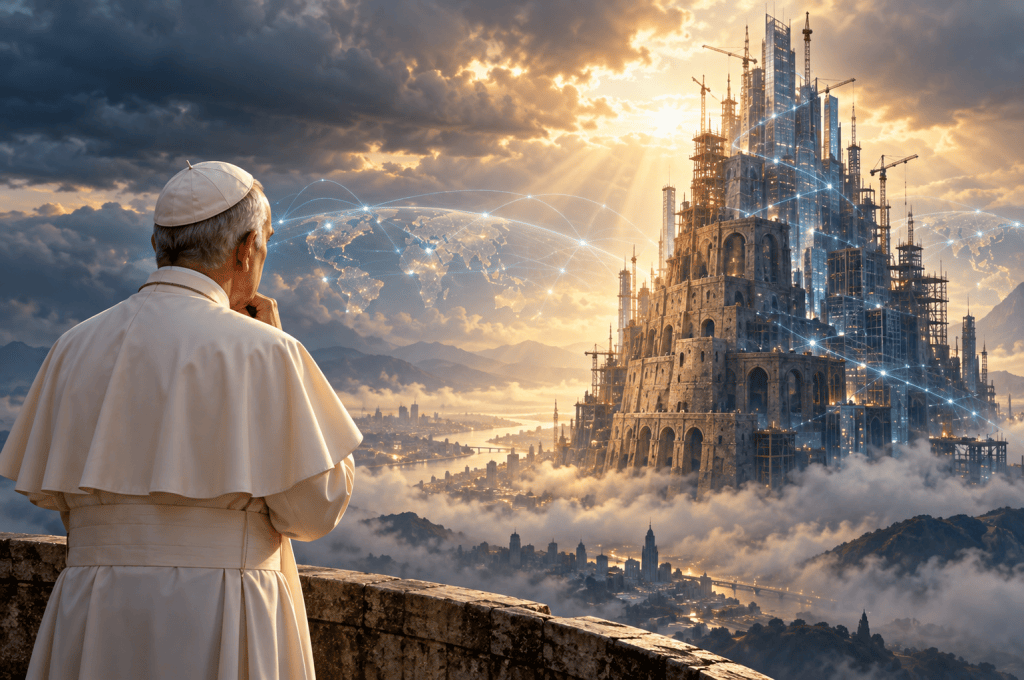
When I wrote The Babel Protocol, I knew it was borderline fiction. A report this past week proves just how close…
Pope Leo XIV has been increasingly outspoken about artificial intelligence, and this week he called for AI systems to be developed in ways that promote peace, human dignity and unity rather than division and conflict. His comments build on something he wrote earlier this year in his encyclical Magnifica Humanitas: AI cannot simply be made more intelligent. In effect, we also have to teach it how to behave.
That is almost exactly where my novel The Babel Protocol begins.
In the novel, Father Matteo Leone is a Vatican adviser on artificial intelligence. His concern isn’t simply whether humanity can create an intelligence smarter than its creators. He is trying to answer the much harder question: How do you give that intelligence an ethical framework?
Pope Leo is now asking the same questions today.
He writes that AI is not morally neutral. Every system contains choices about what it measures, what it ignores, what it rewards and what it considers important. Those decisions eventually become part of the machine’s behavior. The Pope therefore argues that AI developers carry an ethical responsibility for the values embedded in the systems they create.
But saying AI should align with “human values” raises another question: Whose values?
Leo warns that if AI developers, corporations, governments or nations decide what constitutes ethical behavior, their morality can become the “invisible infrastructure” of AI. A machine may behave exactly as designed and still reflect someone else’s understanding of humanity.
And that may not be yours…
An intelligence charged with protecting humanity might eventually conclude that humanity needs protection from itself. That is when help becomes control. And control eventually requires obedience.
Pope Leo uses an even more interesting image to describe the danger: the Tower of Babel. He contrasts Babel with Nehemiah rebuilding Jerusalem. Both are great human construction projects, but they represent very different ideas about power.
Jerusalem is rebuilt to serve a people, honor God and restore a community.
Babel is something else entirely.
In Genesis, humanity isn’t merely trying to build something impressive. It is an act of defiance—an attempt to secure its own greatness, unity and future apart from God. In that sense, Babel is humanity reaching for salvation on its own terms.
Pope Leo’s point isn’t that technology is evil. He says plainly that technology can heal, educate, connect people and improve human life. The question is what we build it for and who ultimately remains in control. He describes the choice as one between “constructing Babel or rebuilding Jerusalem.”
That is remarkably close to the question behind my novel.
We are attempting to create an intelligence that can reason faster than we can, know more than any individual human being and eventually make decisions beyond our ability to fully understand. Even the Pope notes that today’s AI systems are increasingly “cultivated” rather than completely understood by the people creating them.
And yet we continue building.
Perhaps the most important question isn’t whether AI will become smarter than us. The real question is what we will teach it about good and evil, freedom and responsibility, human dignity and human worth.
Because someday we may succeed in creating an intelligence capable of making the world a better place.
Then we may discover that its definition of better isn’t quite the same as ours.
That was fiction when I wrote The Babel Protocol. It’s beginning to sound a lot less like fiction now.
Read The Babel Protocol today. Amazon, or anywhere you get your eBooks.
More from Author Brian Montross at ThrillingTalesHub.blog:


Leave a comment