
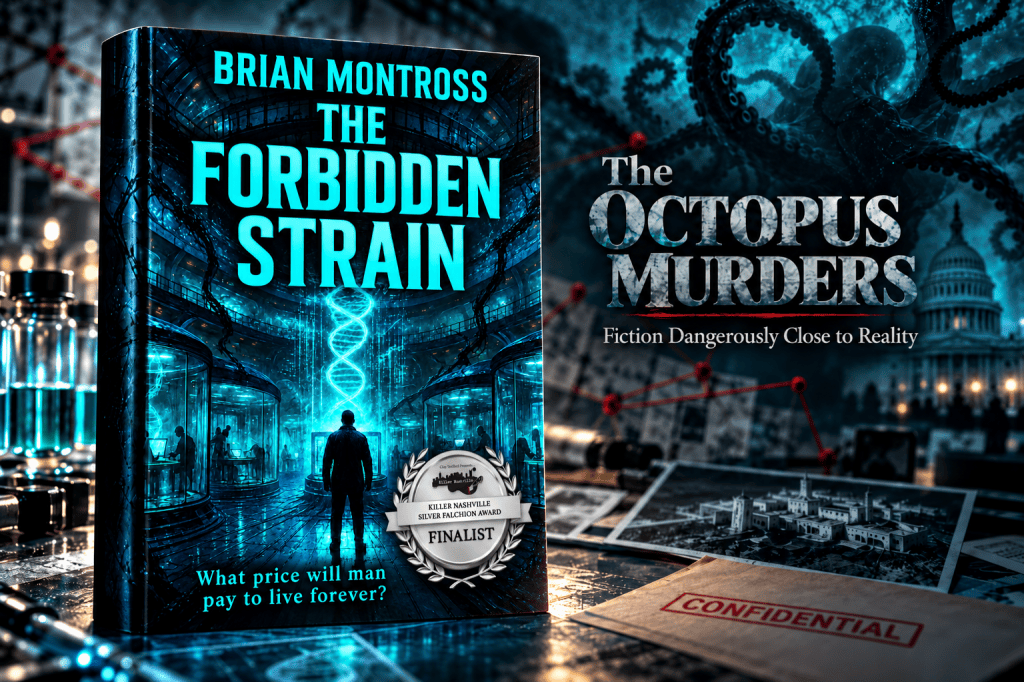
Have you watched Netflix’s American Conspiracy: The Octopus Murders? Or read my thriller, The Forbidden Strain? I watched the documentary while finishing The Forbidden Strain, and something caught me off guard. Parts of this real-life investigation sounded remarkably like the fictional conspiracy I’d been writing.
The Octopus Murders:
In the early 1980s, the Cabazon Band of Mission Indians in California partnered with Wackenhut, a major private security and government contractor. Together, they pursued military technology and weapons projects on sovereign tribal land. That much is documented.
But why operate on a Native American reservation? One allegation was that the partnership sought to exploit tribal sovereignty to avoid certain government restrictions and oversight. Claims emerged of secret chemical and biological weapons research, CIA involvement, and clandestine military operations. Investigators examined those allegations, but the most serious claims were never substantiated.
In 1981, Fred Alvarez, a Cabazon tribal official reportedly investigating corruption, was murdered alongside two others. Whether those killings were connected to a larger intelligence conspiracy was never established.
Now consider The Forbidden Strain.
In my novel, Detective Alejandro Hernandez and FBI Agent Liz Shaw uncover Red Mesa Biotechnics, a clandestine genetic research facility hidden beneath tribal land in northern New Mexico. Behind its secrecy lies dangerous experimentation, powerful financial interests, and people willing to kill to protect what they’re doing.
The parallels are unsettling: tribal land, secretive research, powerful private interests, allegations of government involvement, and murder.
Of course, The Forbidden Strain is fiction. But the Cabazon affair raises an uncomfortable question. What happens when enormous scientific ambition, government secrecy, and private money come together in places where accountability becomes difficult?
Living in northern New Mexico, where Los Alamos has conducted classified research for more than eighty years, I don’t have to look far for inspiration. Our mountains have a long history of secrets.
The documentary doesn’t prove that its most extraordinary accusations were true. But the documented events are troubling enough. And they leave me with a question:
When a discovery becomes too valuable—or too dangerous—to reveal, how far will people go to keep it secret?
If you’ve watched The Octopus Murders or read The Forbidden Strain, I’d love to hear your thoughts. Could something like this happen today?
Brian Montross is the author of The Forbidden Strain, a 2026 Killer Nashville Silver Falchion Award finalist and the second novel in The Chama Conspiracies series. The thriller takes readers beneath the mountains of northern New Mexico, where a murder investigation uncovers a secret that could rewrite humanity.
Check out my latest thriller: The Babel Protocol


Leave a Reply